
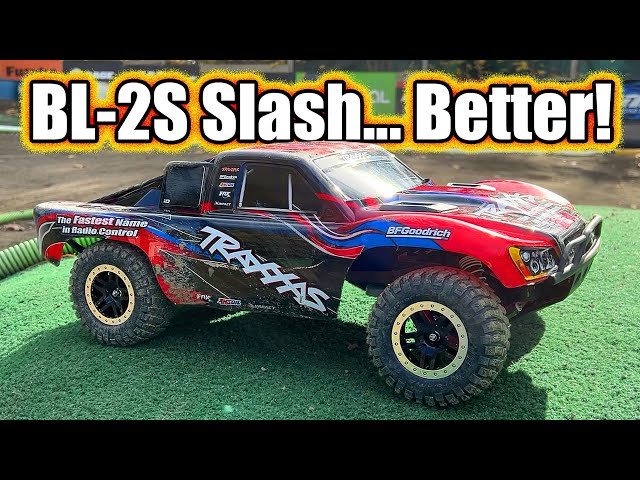
Choosing a Traxxas Slash can feel like picking between a go-kart. A rally car. Both look similar, but the go through is wildly different. You might be leaning toward the smaller one.
Because it's cheaper and fits in a backpack. That's fair.
After looking at the numbers and the real-world headaches, the decision isn't as simple as you'd think. I'll break it down so you don't waste money on a basement shelf queen.
Key Point
- The 1/10 Slash handles grass and rough terrain easily. The 1/16 struggles in anything taller than about an inch.
- 1/16 models suffer from differential clicking out of the box. A shim kit like Team Associated #21141 is almost required on day one, which adds hidden cost and labor.
- The newer BL-2s brushless system on 1/10 versions gives you more torque and cooler running than the old brushed setup, making it the best value right now.
- 1/16 is temptingly cheap, but the upgrades needed to survive 3S LiPo power often push the total past the price of a 1/10 4WD BL-2s.
- If you want a side-by-side spec rundown, our in-depth comparison covers the raw numbers.
Size and Handling: What You'll Feel on the Ground
The 1/16 Slash is small. The data speaks for itself. Its chassis is about 14 inches long. 36 inches, nearly two-thirds longer. The thing is, that difference hits you the moment you try to run it on a normal backyard lawn.
The 1/10 clears 2-inch grass without breaking a sweat. The 1/16 gets bogged down.
Which means but anything with real grass? The little guy simply can't keep up.
Weight plays a bigger role than most most of us realize. The 1/10's heft gives it stability on jumps.
The 1/16 is so light that even mild crosswinds can push it off line; in the air with throttle, when you send the 1/10 off a ramp, you can correct its attitude. The 1/16, because it weighs so little, tends to tumble unpredictably. That's not a skill issue.
Many new drivers blame themselves for awful air control when it's actually the platform's limits.
1/16 Slash
14 in
1/10 Slash
22.36 in
Chassis length comparison — visual scale
The inboard cantilever suspension on the 1/16 looks cool. It's a trickle-down design from the Revo. But it's harder to work on than the 1/10's standard long-travel shocks. You need to remove multiple screws just to check an oil leak.
The 1/10's shock towers are right there, painless and clear. If you're the type who likes wrenching.
That mightn't bother you. It depends.
But for snappy bash sessions, the extra complexity gets old snappy. Hold onto this thought.
Durability: What Breaks First (and Why)
Sure enough. The 1/10 Slash earned its reputation for toughness. Hard to ignore those numbers.
More a lot than not, but there's a catch: the body acts like a parachute on high-speed jumps; air gets trapped under the shell, lifts the front, and the truck flips mid-air. That's not a durability problem per se. But it causes crashes that break other parts.
The key here is that cutting vent holes in the body helps, no, scratch that, but most most of us don't do it until after the first big wreck.
Now, the 1/16's weak spot is the differential. Listen to any owner forum. And you'll hear about the clicking noise right out of the box.
Shim those gears immediately. Team Associated #21141 shims are the go-to fix.
And they cost only a few bucks. Yet about 9 out of 10 new buyers ignore this until the diff strips.
And they're out $25. Actually, hold on.
That's a bit optimistic. Which means it's a design tolerance issue, not a fluke.
Driveshafts are another for instance on both trucks. When you get to 3S LiPo power.
The stock plastic shafts twist and eventually snap. Overall, the 1/10 VXL and even the 1/16 VXL chew them up.
You'll need steel CVDs. For the 1/10, that's a $60 upgrade.
For the 1/16, about $40. When you add that to the cost of a $20 shim kit. And maybe $25 for aluminum shock caps, hmm, let me put it differently, the 1/16's initial price advantage starts to evaporate. That changes the picture quite a bit.
That's why you see so quite a few used 1/16 trucks for sale with a pile of broken parts.
Here's the long and short of it: blocksep matters. But here's the thing: the 1/10's clipless body system. That is the core of it.
Standard on newer models, has made bashing way less annoying. No more lost body clips in the grass. 5mm) are maddeningly painless to drop. You can invest in a bag of spares. But it's one more thing to worry about.
Power Systems: The BL-2s Shakeup and the 3S Problem
Traxxas made a smart move in 2024 by rolling out the BL-2s brushless system on the 1/10 Slash; which is why it sits right between the brushed Titan 12T and the wild VXL-3s. Make of that what you will.
The BL-2s gives you about 30% more torque than brushed and runs much cooler. A brushed motor can hit thermal shutdown. After 10 minutes of a pain use on a hot day. The BL-2s doesn't.
And it's only $30–$40 more than the brushed version. That's the sweet spot.
In practice, the 1/16 Slash VXL can handle 2S and 3S. Kind of surprising, right? That covers it, it's.
For about five minutes. But then you'll likely strip a diff, burn a slipper clutch, or snap a driveshaft. If you look at the actual user feedback across Reddit.
And forums, the consensus is that 3S on the 1/16 is overkill. The truck becomes twitchy to the point of being un-drivable.
The high center of gravity and narrow track — wait, let me rephrase, make it traction roll on every other turn. You can lower the suspension and widen it with aftermarket arms.
But now you're sinking more money into a platform that was supposed to be budget-friendly.
But then you're leaving speed on the table that the 1/10 BL-2s can match or beat while staying planted. Worth pausing on that one.
And the 1/10's 540-size motor has way more low-end grunt. It pulls out of corners harder.
The 1/16's 380-size motor spins blazing but lacks torque — which is why so on loose surfaces, the 1/10 hooks up better. Yet, context matters heavily.
Sure enough, that's where you need to look at total cost of fun. A 1/10 Slash 4WD BL-2s costs about $330.
That changes the picture quite a bit. A 1/16 Slash VXL is $250. Just something to consider. But after the mandatory shims, steel driveshafts, and maybe better tires, you're approaching $330.
You still have a truck that can't handle grass. The side-by-side breakdown spells out those numbers in more detail.
Hidden Costs and Long-Term Upgrades
Many people fixate on the sticker price. That's a mistake. 0mm hardware. But those tiny screws strip if you breathe on them wrong. You'll need a quality set of hex drivers, not the junk L-keys that come in the box.
That's $20. Then you'll discover that even the 1/16's stock tires balloon at high speed.
Most likely the 1/10's larger scale means parts are easier to source at any hobby shop. The aftermarket catalog is immense. For the 1/16, you're ordering online and waiting.
On average, the 1/16 Slash shares a bunch of parts with other Traxxas minis like the 1/16 Summit and E-Revo. So if you already own one of those, you can cannibalize; that might make the 1/16 more attractive if you're deep into the Traxxas mini setup. Otherwise, the 1/10 gives you a more complete. Less frustrating experience out of the box.
One more thing. The 1/10 2WD model teaches better driving habits. Without four-wheel drive to pull you out of slides.
You learn throttle control. The 4WD 1/16 masks mistakes.
Some beginners end up bored. Because they not once learn to manage weight transfer.
In general, if you're new to hobby-grade RC, the 1/10 2WD Slash at $200 (brushed). And the trend keeps going.
Or $260 (BL-2s) might actually make you a better driver faster. That's not a run-of-the-mill beginner recommendation. But the data from local tracks supports it. People who start on 2WD constantly progress to faster lap times within a few months compared to 4WD crutchers.
FAQs
Can the 1/16 Slash run on 3S LiPo?
Yes, but you'll need to shim the differentials and upgrade to steel driveshafts to avoid immediate failure, and most owners find 2S is more reliable and still plenty quick for its size. File that away. You'll see why it matters in a bit.
Is the 1/10 Slash 2WD easier to drive than the 1/16 4WD?
Not easier, but it teaches smoother inputs. The 1/16's four-wheel drive hides sloppy driving. But its short wheelbase and high CG make it flip unexpectedly. The 1/10 2WD demands precision, which builds better skills.
What's the biggest hidden cost with the 1/16 Slash?
For the average user. It's the constant need to buy tiny hardware, shims, and better shocks. What this means is within a few months, plenty of owners spend $80–$120 on upgrades just (as one might expect) to keep it running reliably. While the 1/10 constantly needs nothing but routine maintenance.
Which one handles jumps better?
The 1/10, hands down. Its longer wheelbase and weight give predictable air control. The 1/16 is light and tends to land knocked around by the wind. If jumping is your main thing, go 1/10.
Pick the Truck That Matches Your Real Terrain
You're not picking the better truck. You're picking the better fit. The 1/16 Slash belongs on pavement, indoor skate parks, or very short grass. Make of that what you will.
It's more portable, and if you're careful with 2S. And the shim mod, it can be a riot. The 1/10 Slash does almost everything else with less heartache.
That changes the picture quite a bit. What this means is the BL-2s models, in particular, erase the old argument that brushless was consistently too expensive — the cost gap has shrunk while reliability has jumped.
If you're still undecided. Revisit the complete comparison for the raw specs you might have missed. If you already know which one you're leaning toward, just grab it; both will put a smile on your face, as long as you know what you're signing up for.
🔍 Research Sources
Verified high-authority references used for this article