
The best RC basher under $300 depends on whether you need a complete truck or a strong servo upgrade.
A hard-running RC truck can break a weak steering servo after one bad landing. That is why I reviewed these two HobbyPark servo options for RC cars, trucks, crawlers, and bashers. They are not complete RC bashers. They are replacement or upgrade parts that can improve steering control and durability. If you already own a compatible RC vehicle, either servo may solve slow steering, stripped gears, or poor water resistance. Check your vehicle size, voltage, servo mount, plug, and radio system before ordering.
See the differences between my top picks at a glance.
HobbyPark 35kg High-Torque Servo

The HobbyPark 35kg servo targets RC owners who want more steering force than a basic stock servo can provide. Its listing describes a coreless motor, digital control, stainless steel gears, an aluminum case, and a 180-degree control angle. The stated 35kg torque rating makes it a serious option for many 1/10 trucks, crawlers, buggies, and similar vehicles. The metal gear design also suits drivers who often land hard or run on rough ground.
This servo has a waterproof claim, but I still would not treat that claim as permission to submerge the whole unit. Water protection can vary by seal, cable entry, case fit, and installation quality. You also need to check voltage, dimensions, mounting holes, horn fit, and receiver compatibility before purchase. For a mid-size RC basher, this model looks more balanced than an oversized servo that adds weight and demands more power.
Pros:
- High stated 35kg torque for stronger steering
- Metal gear construction for better impact resistance
- Coreless motor design listed for responsive operation
- Aluminum case helps support the servo body
- Waterproof claim suits wet outdoor driving when installed with care
- 180-degree control angle supports a wide steering range
- Works across several listed RC vehicle types
Cons:
- It is a servo upgrade, not a complete RC basher
- Actual torque depends on the voltage and test method
- It may draw more power than a small stock servo
- Buyers must confirm size and mounting fit before ordering
What Amazon Buyers Are Saying
Amazon feedback can change over time, so I look for repeated themes rather than relying on one short review. Buyers who choose a servo in this class usually focus on steering strength, metal gears, fit, speed, and survival after regular use. The product listing supports those intended uses, but each RC platform can produce a different result.
Potential complaints often involve fit, wiring, voltage, or steering setup rather than the basic idea of a high-torque servo. A servo can feel weak when the vehicle battery cannot supply enough current. It can also bind if the steering links sit at a poor angle. I recommend reading the latest buyer comments and checking the exact measurements before placing an order.
My Recommendation
I recommend the HobbyPark 35kg servo for drivers who own a compatible 1/10 RC truck, crawler, buggy, or moderate-size basher. It offers a practical mix of torque, metal gears, case strength, and claimed water protection. I would not buy it as a blind replacement. I would first verify voltage, dimensions, connector type, and servo horn fit. For many mid-size builds, it is the more sensible choice than jumping straight to a very large servo.
HobbyPark 75kg Waterproof Brushless Servo
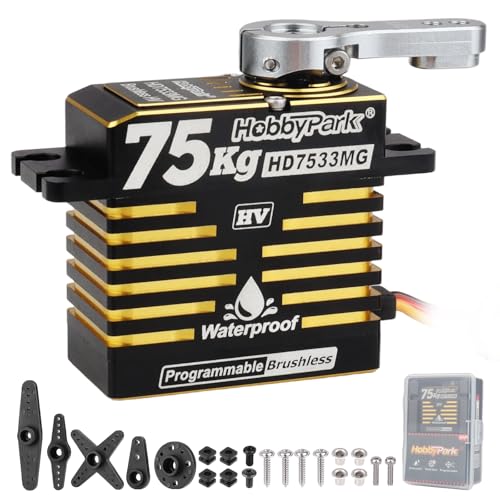
The HobbyPark 75kg servo is the heavy-duty option in this comparison. Its listing describes a waterproof, high-voltage servo with a brushless motor, fast response, and full metal gears. The stated 75kg rating places it in a much stronger class than the 35kg model. It is listed for 1/6, 1/7, 1/8, and 1/10 RC cars, trucks, crawlers, and bashers.
That extra strength can help a large RC vehicle turn its tires on loose ground or resist steering shock after a rough landing. It can also create new demands on the vehicle. A large servo may weigh more, use more electrical power, and need a radio system or receiver that supports its operating voltage. I would treat this model as a serious upgrade for a large platform, not as an automatic choice for every RC basher.
Pros:
- Very high stated 75kg torque
- Full metal gears suit demanding off-road use
- Brushless motor design may support efficient, fast operation
- High-voltage design offers more setup flexibility when supported
- Waterproof claim fits wet outdoor driving with proper care
- Listed for several large RC vehicle scales
- Strong option for heavy tires and high steering loads
Cons:
- It can be excessive for a light 1/10 vehicle
- High-voltage support does not mean every receiver can use it
- Large torque may expose weak servo horns, links, or mounts
- Actual size and current needs must match the vehicle
- It is not a complete RC basher or steering system
What Amazon Buyers Are Saying
The most useful buyer feedback for a high-torque servo usually covers real fit, steering speed, heat, noise, and performance under load. The product listing presents this model as a fast and powerful choice for larger RC platforms. Still, listing claims do not replace a careful check of the latest customer reviews and the maker’s setup information.
Some buyers may value the metal gear train and strong steering output. Others may report issues caused by incorrect voltage, an unsuitable servo saver, poor mounting, or a receiver that cannot supply enough current. Those points matter with any 75kg servo. I would pay close attention to comments about dimensions, plug use, programming, and long-term heat during hard driving.
My Recommendation
I recommend the HobbyPark 75kg servo for a large, heavy, or highly modified RC vehicle that truly needs extra steering force. It makes less sense for a small truck with limited space or a weak electronic system. Before buying, confirm the servo’s physical size, operating voltage, receiver output, BEC capacity, and steering hardware. If those parts match, this is the stronger choice for demanding bashing.
What “Best RC Basher Under $300” Really Means
Searchers often use the phrase best RC basher under 300 to mean a complete ready-to-run truck. A ready-to-run model normally includes the chassis, motor, speed controller, steering servo, radio transmitter, receiver, battery needs, and charger requirements. The two products reviewed here do not include those parts. They are steering servos.
That difference matters. If you need a full RC truck, these products cannot meet that need by themselves. If you already own a basher and need better steering, they may be useful upgrades. A strong servo can improve tire control, but it cannot fix a bent chassis, weak suspension, poor gearing, or an underpowered battery system.
I also would not judge a servo only by its torque number. Torque ratings can use different test methods. The number may change with voltage. Speed, gear quality, case design, deadband, heat, current draw, and fit all matter. A good match often performs better than the biggest number on the package.
How to Choose the Best RC Basher Under 300
Choosing the best RC basher under 300 starts with a clear decision. Do you need a full ready-to-run vehicle, or do you need a replacement servo for a truck you already own? These HobbyPark products suit the second need. Use the checks below to avoid buying a part that cannot fit or work with your current setup.
1. Match the Servo to Your Vehicle Size
Start with the scale and weight of your RC vehicle. A small 1/10 truck may work well with a moderate high-torque servo. A heavy 1/8 or 1/7 truck may need much more force. A 1/6 model can place a very high load on the steering system, especially with large tires and low-grip terrain.
Scale alone does not tell the whole story. Tire size, wheel offset, steering geometry, terrain, and driving style also change the load. A crawler with sticky tires can stress a servo while standing still. A fast basher can shock the steering system during jumps and hard landings.
Measure the old servo before ordering. Check its length, width, height, mounting tab position, and screw spacing. Then compare the replacement. A servo that has more torque but does not fit the tray can create more work than it saves.
2. Check Voltage, Current, and Receiver Support
Voltage is one of the most important checks. A high-voltage servo may require more voltage than the stock receiver system provides. Some vehicles use a built-in electronic speed controller with a fixed BEC output. The BEC is the circuit that sends power to the receiver and servo.
If the BEC cannot supply enough current, the servo may move slowly, reset the receiver, or create steering glitches. In some cases, the vehicle may lose control under heavy load. Never assume that a larger servo will work safely just because its plug looks familiar.
Check the vehicle manual, receiver details, and servo listing. If the power system needs an external BEC, include that part in your budget. A proper installation may also need a new servo horn, stronger steering links, or a better servo saver.
3. Compare Torque, Speed, and Real-World Value
Torque helps the servo turn the tires. Speed affects how quickly it reaches the commanded position. A very strong but slow servo may feel dull in a fast truck. A very fast servo with low torque may struggle when the tires press into gravel or grass.
For a moderate truck, the 35kg HobbyPark model looks like the more balanced option. For a large truck with heavy tires, the 75kg model offers more stated force. That does not make the 75kg model better in every vehicle. Extra capacity can increase weight, power use, and stress on other parts.
Look at the total cost. The servo price is only one part of an upgrade. Add a compatible horn, servo saver, BEC, mounting parts, and possible installation time. The best RC basher under 300 is still poor value if a replacement servo does not match the rest of the vehicle.
Installation Tips for a Basher Steering Servo
Remove the battery before you work on the vehicle. This simple step reduces the risk of accidental motor movement and electrical damage. Take a photo of the original servo wiring and steering position. That photo can help if you need to restore the setup.
Center the servo before attaching the horn. Connect the servo to the receiver, power the system, and set the steering trim to neutral. Then install the horn as close to the center position as possible. Do not force the horn onto the spline at a sharp angle.
Set the steering endpoints after installation. Endpoints stop the servo before the steering parts bind. If the servo keeps pushing after the wheels reach their limit, it can build heat and drain the battery. Binding can also damage gears, links, and the servo mount.
Check the servo saver and steering links. A saver that sits too loose may reduce steering accuracy. A saver that sits too tight may pass too much impact to the servo gears. The correct setting depends on the vehicle and the part maker’s instructions.
Keep the wiring away from gears, driveshafts, and hot motor parts. Use a small wire tie if needed, but leave enough slack for suspension movement. After the first short run, inspect the screws, horn, links, and case. Do not begin with a long jump session before you confirm that the steering works correctly.
35kg Versus 75kg Servo: Which Is Better?
The 35kg model is the easier recommendation for many mid-size RC vehicles. Its stated torque should be enough for a wide range of 1/10 trucks and crawlers when the steering system works well. It also avoids some of the extra demands that come with a much larger servo.
The 75kg model makes more sense when the truck is heavy, the tires are large, or the steering load is high. It may suit a large 1/8, 1/7, or 1/6 platform better. It still needs a suitable power source and a strong mount. More torque cannot compensate for an overloaded BEC or a servo tray that flexes.
For a stock lightweight vehicle, I would not pay for force that the chassis cannot use. For a modified vehicle with added weight and large tires, I would not use a small servo simply because it costs less. Match the part to the load.
Common Mistakes to Avoid
The first mistake is confusing a servo with a complete RC basher. These products only control steering. They do not include a motor, battery, charger, radio, chassis, shocks, tires, or drivetrain.
The second mistake is trusting the torque number without checking voltage. A rating at one voltage may not equal the output at another voltage. Read the product details and use the correct power system.
The third mistake is ignoring the servo saver. A very strong servo can still steer poorly if the saver slips too much. It can also damage the vehicle if the saver transfers every impact to the steering links.
The fourth mistake is skipping endpoint setup. Binding places stress on the motor and gears. It can also cause unwanted heat. Always test full left and full right movement with the wheels off the ground.
The fifth mistake is assuming “waterproof” means “submersible.” Water can enter through a cable, case seam, or damaged seal. Dry the vehicle after wet driving and inspect the servo if it has faced deep water.
Are These Good Upgrades for a Complete RC Basher?
They can be, if the vehicle accepts the size and electrical needs. The 35kg model may help a mid-size truck that feels weak at the steering wheel. The 75kg model may help a heavy basher with large tires. In both cases, the servo works as one part of a larger system.
Do not expect a servo upgrade to improve top speed. It will not add motor power or extend battery run time. Its main job is to move and hold the steering system. A better servo can make steering feel firmer and more controlled, but the result depends on the rest of the vehicle.
I would also inspect the servo mount before installing either model. A flexible mount wastes steering force. A cracked mount can let the servo shift under load. Stronger steering often reveals weak links elsewhere, so inspect the horn, saver, tie rods, knuckles, and bearings too.
Who Should Buy the 35kg Model?
Choose the 35kg model if you own a compatible 1/10 truck, crawler, buggy, or moderate basher. It fits the needs of drivers who want more force than a basic stock servo. It also suits an owner who wants metal gears and a case designed for outdoor use.
This model is a better starting point for a first servo upgrade. It offers strong stated output without the extreme rating of the larger model. I would still check the BEC and dimensions, but the overall match should be easier for many mid-size vehicles.
Who Should Buy the 75kg Model?
Choose the 75kg model if your RC vehicle is large, heavy, or heavily modified. It may fit a truck with big tires, added armor, or high steering loads. It also suits an experienced hobbyist who understands voltage, BEC limits, endpoints, and servo mounting.
I would not choose it only because 75kg sounds better. If the vehicle cannot supply the needed power, the larger servo may perform worse than a smaller, well-matched unit. Confirm the full system before ordering.
Final Verdict: Which Should You Buy?
For most mid-size vehicles, I prefer the HobbyPark 35kg servo because it offers a balanced mix of force, fit, and value. For a large, heavy truck, the HobbyPark 75kg servo is the stronger upgrade.
Neither product is a complete RC basher under $300. They are servo upgrades. Match the voltage, size, and BEC before buying for the best result.
FAQs Of best rc basher under 300
Are these products complete RC bashers?
No. Both products are steering servos. They do not include a chassis, motor, battery, charger, transmitter, or complete RC truck.
Which servo is better for a 1/10 RC basher?
The 35kg model is the more balanced choice for many compatible 1/10 vehicles. Check the size, voltage, BEC, and mounting pattern first.
Is the 75kg servo suitable for a 1/8 RC truck?
It may suit a compatible 1/8 truck with heavy steering loads. Confirm the physical fit, operating voltage, receiver support, and current capacity before installation.
Can I run a waterproof servo under water?
No. A waterproof claim does not guarantee safe deep submersion. Keep water exposure reasonable, dry the vehicle after wet use, and inspect the case and cable.
What should I check before buying an RC servo upgrade?
Check torque, speed, dimensions, voltage, connector, mounting holes, servo horn fit, BEC capacity, and steering endpoint support.